
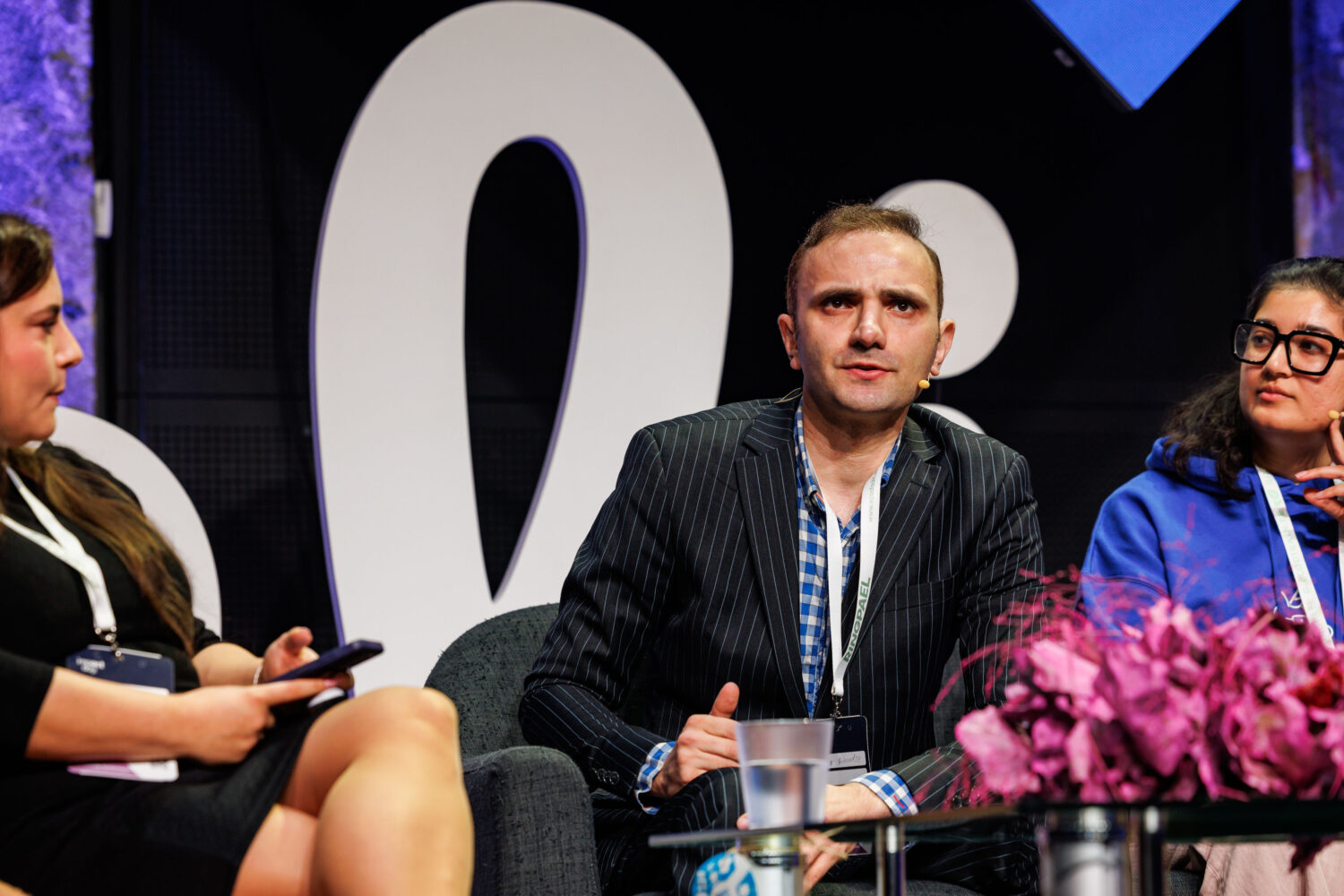
Vladimer Botsvadze – guest speaker at Impact Day 2025 (“ID25”), a Thinkers360 ‘Top 20 Global AI Thought Leader’, and member of the US AI Institute’s Advisory Board – joins us in reflection and takes a forward look into a couple of the talking points that form part of this year’s programme.
Read on for his opinion on the development of AI as a growth tool, how to close the ‘Innovation Gap’, and what action he proposes to maximise resilience, innovation, and long-term growth.
“How did you become involved in ID25, and what most inspired you about the event itself?”
My journey to ID25 began with a deep admiration for Estonia, one of the world’s most innovative countries. Estonia embodies something rare: bold thinking, digital leadership, and a culture that dares to build globally.
As a thought leader, I’m always looking to engage with forward-thinking ecosystems shaping the future, so Tallinn was on my radar for a while.
Erkki Kubber invited me to speak, and from the very beginning, I felt the event’s authenticity and ambition. What most inspired me was not only the scale – bringing together over 2,500 changemakers from across Europe – but the mindset.
Estonia values perseverance and attitude over credentials, and Impact Day’s founders are mission-driven and think globally. You build not only for profit but also for the long term.
Speaking at ID25 exceeded my expectations; the energy in the room, the depth of conversations, and the shared commitment to innovation and sustainability made it one of the biggest milestones of my career.
I connected with visionary entrepreneurs, policymakers, investors, and sustainability pioneers who are not just discussing the future – they are building it.
I am deeply grateful to the entire Impact Day team for their trust, their warm welcome, and for creating a platform that truly celebrates innovation with purpose. Events like this remind us that when technology, leadership, and ethics align, extraordinary things happen.
“At ID25, you argued that AI is a catalyst for a complete mindset shift, not just a tool for efficiency. In the context of global trends, how should investors and boards deploy the capital freed up by AI? Is the real ROI simply cost-cutting, or should it drive aggressive reinvestment and market expansion?”
I made the case that AI is not a productivity plugin – it’s a paradigm shift. When we treat it as just another automation layer, we limit its impact to incremental efficiency. But when we recognise it as a catalyst for rethinking how value is created, captured, and scaled, the conversation changes entirely.
Globally, we’re at an inflexion point. Across markets , from North America to Southeast Asia , AI is compressing cycle times, flattening cost curves, and democratising capabilities that once required enormous capital.
The question for investors and boards isn’t whether AI can reduce operating expenses – it can – the real strategic question is what to do with the capacity it unlocks.
If AI simply drives cost-cutting, you may see a short-term EPS bump, but that is a defensive strategy. The true ROI comes from aggressive reinvestment. Capital freed by AI should flow into three areas:
Innovation Velocity
AI reduces the cost of experimentation – in product design, customer insights, and go-to-market testing. Boards should be asking management teams how they are using AI to double or triple their rate of intelligent experimentation. In today’s environment, the companies that learn fastest win.
Market Expansion
AI lowers the marginal cost of personalisation and localisation. That means companies can profitably serve segments and geographies that were previously unreachable. Instead of trimming budgets, forward-thinking organisations should redeploy capital to expand distribution, deepen customer relationships, and build ecosystem partnerships.
Talent Transformation
AI doesn’t eliminate the need for people; it amplifies the need for higher-order thinking – judgment, creativity, systems design. Investors who pressure companies to simply “do more with fewer people” may undermine long-term value creation.
The smarter play is to reskill, elevate, and redesign roles so human capability compounds alongside machine intelligence.
The global trend is clear: capital is becoming less scarce than imagination. AI is widening the gap between companies that reinvest boldly and those that optimise timidly. Cost savings are the floor. Strategic reinvestment is the ceiling.
The real ROI isn’t cost-cutting. That’s table stakes. The real return is strategic acceleration. AI gives boards and investors a once-in-a-generation opportunity to reallocate capital toward growth, resilience, and market leadership.
Organisations that treat AI as a mindset shift – not just a tool – will define the next decade.
“How do you see technology evolving over the next five years to help C-level executives break free from managing legacy processes and, instead, focus on human-centric growth and authentic brand building?”
Technology will shift from being primarily an operational support system to becoming an autonomous execution layer. That transformation is what will finally free C-level leaders from the gravitational pull of legacy processes.
We’re already seeing the early signals: the rise of generative AI, accelerated by platforms like OpenAI, has moved us beyond simple automation into decision augmentation.
The next phase is orchestration – systems that don’t just produce outputs, but manage workflows across finance, operations, marketing, compliance, and customer experience.
When AI agents can monitor KPIs, flag anomalies, simulate strategic scenarios, and even execute routine decisions within guardrails, the executive role changes fundamentally.
Historically, digital transformation meant layering dashboards on top of complexity. Over the next five years, technology will actually collapse complexity. Legacy ERP systems, static org charts, and manual reporting cycles will increasingly be abstracted behind intelligent layers.
Instead of spending executive time reconciling data and managing process friction, leaders will engage with real-time strategic intelligence. That means fewer meetings about alignment – and more time spent shaping narrative, culture, and direction.
This is where human-centric growth becomes the real differentiator. When operational drag decreases, attention becomes the scarce resource. Technology will handle coordination; executives will handle meaning. The brands that win won’t just be efficient – they’ll be emotionally resonant.
AI can analyse sentiment and optimise messaging, but authenticity still requires human conviction. Leaders will need to articulate purpose, values, and long-term vision with greater clarity than ever before.
We’ll also see technology empowering decentralised creativity. With generative tools embedded across teams, brand storytelling will no longer be gated by production bottlenecks. Small, agile teams will test campaigns, build communities, and iterate in real time.
Executives won’t need to micromanage creative output; they’ll need to curate coherence, ensuring that rapid experimentation still ladders up to a unified brand identity.
Perhaps most importantly, technology will surface a new leadership metric: cognitive bandwidth. The CEOs who thrive will be those who intentionally design organisations where machines absorb complexity and humans focus on trust, relationships, and innovation.
Breaking free from legacy processes isn’t about abandoning discipline; it’s about redesigning systems so that discipline is embedded in the architecture, not enforced through bureaucracy.
In five years, the most effective C-level leaders won’t be the best operators. They’ll be the best orchestrators of intelligence and the clearest stewards of human connection.
Technology will manage the mechanics. Executives will shape the meaning.
“Many European leaders feel that heavy regulation puts them at a disadvantage against the speed of US or Chinese competitors. At ID25, you suggested European investment in AI tech should quadruple. What’s the biggest challenge facing these established enterprises in closing the ‘Innovation Gap’, and how can they prevent bureaucracy from stifling their growth and scalability?”
They’re right to worry about speed – but the deeper issue behind the so-called “Innovation Gap” isn’t regulation alone. It’s fragmentation. The US benefits from a single, deeply integrated capital market and a culture that tolerates risk at scale. China aligns industrial policy, capital, and execution with extraordinary coordination.
Europe, by contrast, often tries to innovate across 27 regulatory systems, multiple capital markets, and differing national priorities. Even with ambitious frameworks like the European Union AI Act, clarity does not automatically translate into competitive momentum.
The biggest challenge for established European enterprises is not compliance itself – it’s organisational inertia layered on top of regulatory complexity. Large incumbents are optimised for stability, predictability, and incremental improvement.
Breakthrough AI innovation, however, requires experimentation, tolerance for failure, and rapid capital deployment. When risk committees, procurement cycles, and cross-border legal reviews move more slowly than product cycles in Silicon Valley or Shenzhen, scale becomes elusive.
Regulation then becomes a convenient scapegoat for what is often a cultural and structural slowdown.
Closing the gap requires two parallel shifts:
Investment Must Match Ambition
If Europe wants sovereign AI capabilities, it cannot rely on funding levels that are a fraction of those mobilised around companies like OpenAI or ByteDance.
Quadrupling AI investment is not just about money – it’s about concentrating capital into fewer, globally competitive champions rather than dispersing it thinly across many cautious pilots. Scale wins in AI, and scale demands conviction.
Enterprises Must Redesign Governance Around Speed
That means creating regulatory “fast lanes” within organisations – dedicated AI units with pre-approved risk frameworks, shorter procurement cycles, and executive-level decision authority.
Europe does not need to abandon its values of privacy, safety, and transparency. But it must separate responsible oversight from procedural drag. Smart regulation should function as guardrails, not roadblocks.
Finally, preventing bureaucracy from stifling growth requires reframing compliance as a competitive advantage. Europe can lead in trusted AI systems that are secure, auditable, and aligned with democratic norms.
In a world increasingly concerned about AI misuse, that positioning matters. But trust alone does not scale; execution does. The future belongs to enterprises that combine Europe’s regulatory credibility with Silicon Valley’s urgency and China’s industrial focus.
The innovation gap is not inevitable. It is a coordination problem. And coordination – between capital, policy, and corporate leadership – is something Europe is fully capable of mastering if it chooses speed as a strategic priority rather than a cultural discomfort.
“If you had the power to implement one transformative policy across the NB8 economic region, what bold decision would you make to maximise resilience, innovation, and long-term growth for businesses and citizens alike?”
I would establish a unified, cross-border “Innovation and Resilience Initiative” dedicated to fast-tracking investments in AI, clean energy, digital infrastructure, and workforce development, while dramatically simplifying regulations to enable rapid scaling across all eight countries.
The NB8 is home to remarkable talent and technological leadership. However, its greatest obstacle is fragmentation – differing regulations, funding streams, and priorities slow down innovation and dilute impact.
By creating a single, well-funded initiative with clear governance, the region could harmonise policies, pool capital, and streamline project approvals.
This would unleash a wave of innovation that is faster, bolder, and more coordinated, turning the NB8 into a resilient powerhouse capable of withstanding global shocks, from supply chain disruptions to geopolitical crises.
Beyond economics, this move would ensure that resilience is built into every layer – from equipping workers with new skills to transitioning energy systems toward sustainability.
It would transform the NB8 into a global example of how smart, collaborative policy and investment can create economies that don’t just survive uncertainty but thrive because of it.
This decisive action would empower businesses, attract global investment, and give citizens the confidence that their region is ready for the challenges and opportunities of tomorrow.
It’s a vision where resilience and growth go hand in hand – made possible by bold leadership and collective will.
